
About Us
The Photography Ethics Centre is an organisation dedicated to advancing ethical literacy and practice in photography. Since 2017, we have engaged in critical conversation about the power of photography in shaping how we see and understand the world.
-
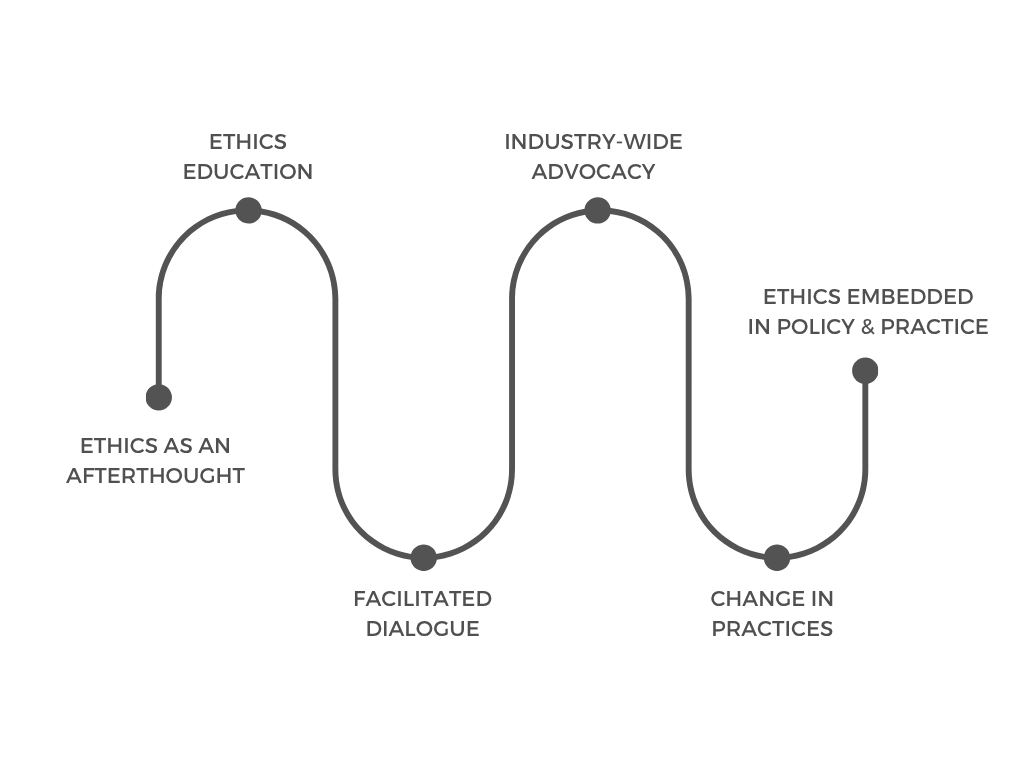
Our mission is to educate, facilitate, and advocate for policy and practice in photography.
Educate: We develop visual and ethical literacy through workshops and online courses.
Facilitate: We create spaces for critical dialogue and community through the biennial Photography Ethics Symposium and Researcher in Residence programme.
Advocate: We work towards changes in policy and practice through The Photo Ethics Podcast, Statement of Ethics Campaign, research and consultancy.
Together, these activities reflect our theory of change that works towards embedding ethics in photographic practice and policy: education builds the foundations of ethical literacy; dialogue enables practitioners to develop their practice with peers; and continued research and campaigning advocate for wider change.
-
Across the photography and visual media industries, ethics are often described in terms of codes or guidelines, and ethical debates are often reduced to descriptions of “ethical” or “unethical” behaviour. We believe that this language is incredibly limiting. Instead of approaching photography ethics in these binary terms, we advocate for a principles-based approach to ethics.
A principles-based approach to ethics is about applying key principles like responsibility, power, and dignity to how we make, share, and consume visual media. A principles-based approach recognises that everyone will answer ethical questions in their own way, based on their own life experience, and personal judgments, because ethics are subjective, contextual, and fluid.
In order to apply this approach in practice, we need image-makers who are ethically literate. Ethical literacy is about having the skills to navigate ethical dilemmas, and having the language to describe your decisions. These skills include things like critical thinking, situational awareness, and cultural sensitivity.
At the Photography Ethics Centre, we do not offer checklists of ethical guidelines. Instead, we help image-makers and image-users develop the skills to think critically about ethics in their work and the language to define their own ethical practice.
-
Since 2017, we have reached more than 4,000 people through events, workshops and online courses. We have produced 78 episodes of the Photo Ethics Podcast, with more than 30,000 global downloads, featuring practitioners and researchers from a wide range of geographies, backgrounds and experiences. Beyond numbers, feedback from our recent Symposium speaks to the qualitative impact of our work: “Being fairly new to the field, the Symposium was an incredibly welcoming and generative space for me, which encouraged me to keep developing my practice, learn and share with everyone.” – Joyce Mak, KCL.
In the nine years since we began, our work has contributed to increased awareness and understanding of photography ethics, yet the principles at the heart of our work – representation, responsibility and respect – feel more urgent now than ever. We collaborate with organisations including the Royal Photographic Society, World Press Photo Foundation, photographies and the Ethical Journalism Network, to expand our impact and work towards embedding ethics into all levels of the industry and society.
Our work serves photographers, visual journalists, students, educators, researchers and organisations that make, commission, publish, archive and share photography. Rather than prescribing what is “ethical” or “unethical”, we advocate for a principles-based approach to ethical literacy that encourages greater consideration of positionality and reflexivity.
-
We endeavour to hold ourselves accountable to the ethical standards reflected in the following values and commitments, and to continue to evolve our ethical approach as an organisation.
Our values
Respect: We believe that people come first. Our interactions with others are built on respect.
Representation: We believe that representation matters. We seek to amplify the voices of people who have frequently been left out of key debates in the photography industry by ensuring that people from a wide range of backgrounds and experiences are represented across our programmes.
Responsibility: We believe that photographs are powerful. We strive to use this power responsibly by choosing appropriate images to illustrate our materials. We work to set a good example of best practice by carefully considering how we use and from where we source photographs.
Our commitments
To inclusive language: We believe that language shapes both thoughts and actions. Therefore, we are mindful of the language we use, avoiding words and phrases that replicate or reinforce a violent or colonialist mindset. We are grateful to Diversify Photo who published a guide to non-violent language.
To accessibility: We believe that the internet should be an accessible space. We are working to make our content accessible to everyone by educating our team about web content accessibility and by implementing improvements.
To the planet: We believe that we have a responsibility to the natural environment. We are working toward carbon neutrality by using solar panels, by using an email provider and domain host that invests in carbon offsets, and by using a merchandise supplier that is certified as carbon neutral by the Carbon Trust.
-
"Social enterprise is about changing the world through business. Social enterprises exist and trade not to maximise private profit, but to further their social and environmental aims. In short, social enterprise is about business where everyone profits." (Claire Dove OBE DL, Social Enterprise UK)
The Photography Ethics Centre operates a social enterprise approach with the aim of raising awareness about visual media ethics through educational training programmes. Our social enterprise model means that profits gained through our tariffed services enable us to offer programmes like our self-paced online course and our podcast for free to photographers around the world.
Why do we offer things for free? Because we think visual media ethics is important, and we want people to learn about it. It's as simple as that.